Basler 10GigE Cameras and Components for High-Speed Machine Vision
Basler’s new ace 2 10GigE cameras, featuring RDMA technology and Power over Ethernet (PoE), deliver high-resolution images at speeds of up to 10 Gbps. Combined with matched network interface cards, pylon software, and accessories, they form a scalable machine vision system that simplifies integration and reduces overall costs.
High-performance vision without unnecessary complexity
High-resolution industrial cameras and multi-camera systems generate enormous amounts of image data. Transmitting and processing this data without delays or excessive CPU load is a growing challenge, particularly in demanding machine vision applications.
Basler addresses this challenge with a complete 10GigE vision system, combining compact ace 2 industrial cameras, RDMA-enabled network interface cards, pylon software supporting GigE Vision 3.0, and compatible accessories.
The coordinated system reliably transfers image data at the full 10 Gbps bandwidth while minimizing CPU utilization and latency. This enables faster image processing, more efficient system operation, and easier expansion.
Compact ace 2 10GigE cameras with impressive performance
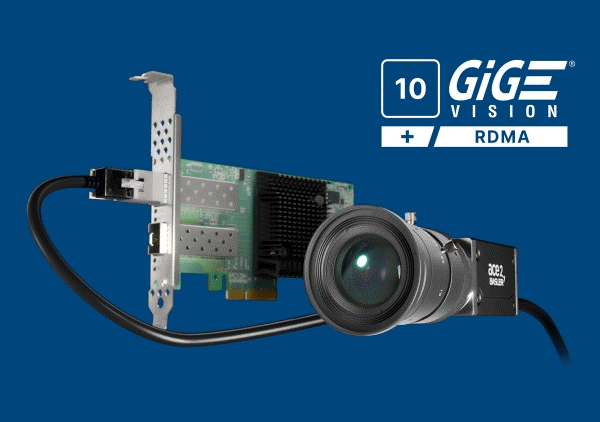
Despite their compact dimensions of just 29×29×61.5 mm, Basler ace 2 10GigE cameras offer high image quality and performance. Key features include:
- Up to 24.4 MP resolution – Detailed image acquisition for demanding inspection tasks.
- Up to 232 fps – High frame rates for fast-moving objects and high-throughput production lines.
- Sony Pregius S sensors – Available for imaging in the visible and UV spectrum.
- 10GigE interface with RDMA – High-speed data transfer with reduced CPU load and very low latency.
- Power over Ethernet (PoE) – Data and power transmission through a single Ethernet cable.
- Less than 7 W power consumption – Reduced heat generation and operating costs.
- Compact housing – Space-saving integration into machines and multi-camera configurations.
RDMA technology for efficient image data transfer
One of the key advantages of Basler’s 10GigE system is Remote Direct Memory Access (RDMA).
Unlike conventional data transmission, which requires extensive CPU involvement, RDMA enables image data to be transferred directly to the host computer’s memory with significantly less CPU processing overhead.
This provides three major benefits: reduced CPU utilization, very low transmission latency, and more processing resources available for image analysis.
Combined with the high bandwidth of 10GigE, RDMA is particularly valuable for multi-camera systems and applications requiring continuous processing of large image datasets.

A complete 10GigE vision system from a single source

High-speed image acquisition requires more than a powerful camera. Network interfaces, software, lenses, lighting, and cables must work together reliably.
Basler offers a coordinated portfolio of components:
- 10GigE network interface cards (RNICs) with RDMA support and RJ45 or SFP+ interfaces.
- PoE-enabled RJ45 connectivity for simplified cabling and installation.
- pylon Software Suite with GigE Vision 3.0 support for camera integration and operation.
- Fixed focal length and telecentric lenses matched to different sensor sizes.
- Compatible lighting solutions and cables for reliable image acquisition.
By selecting components designed to work together, system integrators and machine builders can reduce compatibility issues, integration time, and total cost of ownership.
Where do Basler 10GigE cameras deliver the greatest benefits?
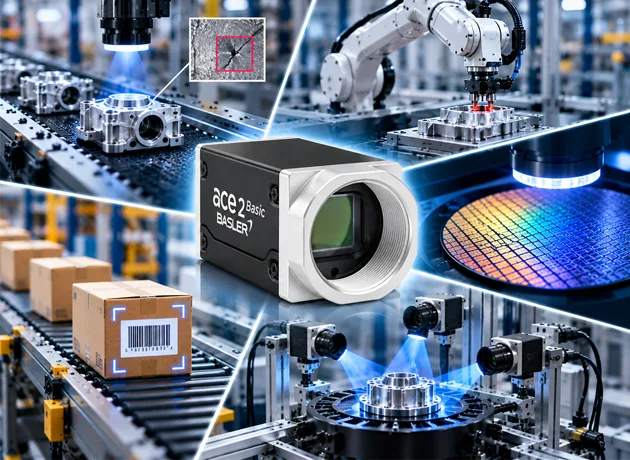
The combination of high resolution, high frame rates, and efficient data transmission makes the system suitable for data-intensive industrial applications, including:
- Automated quality inspection – High-speed detection of defects and detailed product inspection.
- Robotics and robot guidance – Low-latency image transmission for responsive robot control.
- Semiconductor and wafer inspection – High-resolution imaging of fine structures and small defects.
- Logistics and intralogistics – Fast image acquisition for automated identification, sorting, and inspection.
- Multi-camera vision systems – Scalable configurations requiring high data throughput and efficient processing.
Want to know more?

Fill out the contact form and we will get back to you shortly.
Don’t miss any news.
Subscribe to our newsletter!